Author: ctimmermann28

  • Transaction Coordinator vs. Attorney vs. Title Company: Who Actually Does What?

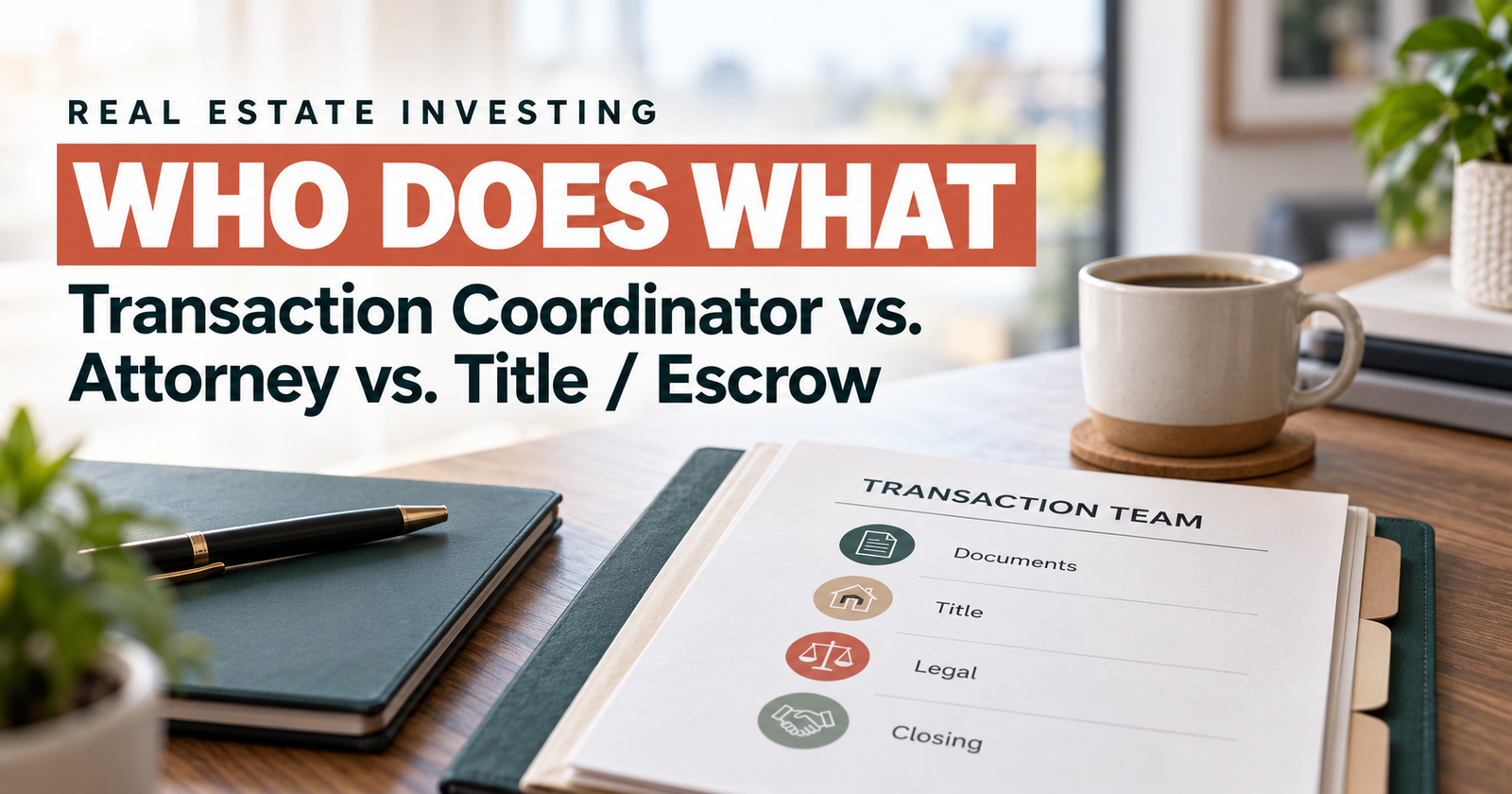
    Transaction Coordinator vs. Attorney vs. Title Company: Who Actually Does What?

    Getting a deal from signed contract to closing usually takes a small team. The tricky part is knowing who owns which piece.

    Who orders title? Who drafts the legal documents? Can your transaction coordinator review a title report? Who chases signatures? Who fixes a title problem? And who makes sure everyone actually has what they need?

    These roles overlap just enough to cause confusion, especially on creative finance deals.

    Three of the most important players are your transaction coordinator (TC), your attorney, and your title or escrow company. They work closely together, but their jobs are very different. Get clear on those differences and you’ll avoid delays, dropped tasks, and that sinking moment when you realize everyone thought someone else was handling it.

    The Transaction Coordinator: Keeping the Deal Moving

    Think of your TC as the person who keeps the transaction in motion.

    A good TC keeps documents organized, stays in touch with every party, tracks what’s missing, spots roadblocks early, and keeps pushing the deal toward the closing table.

    Depending on your agreement, a TC may:

    • Organize transaction documents
    • Open escrow
    • Request a title report
    • Review title reports and send you their observations
    • Follow up with parties about missing items
    • Track roadblocks
    • Confirm contract details with you
    • Review closing or lending documents and flag discrepancies
    • Help coordinate inspections and appraisals
    • Help set up loan servicing
    • Coordinate notary signings
    • Track lending transactions
    • Help with certain post-closing transfers on creative deals

    In short: coordination and administration.

    Yes, Your TC Can Handle Contract Signatures

    This is a big one for investors.

    A TC can run the entire signature process: preparing the document for e-signature, sending it to the right people, tracking who’s signed, chasing missing signatures or initials, and distributing the fully executed copy.

    A TC can also work from contract templates you already use, whether they were prepared by your attorney, provided by your investing community, or otherwise approved.

    Say you hand your TC an approved template along with these terms:

    • Purchase price: $85,000
    • Down payment: $5,000
    • Interest rate: 9%
    • Buyer: John Smith
    • Seller: ABC Investments LLC

    Your TC can drop those details into the right fields, prep the document for signing, manage the process, and send everyone the completed contract.

    The key distinction: the TC is filling in and managing an approved document, not writing legal language or deciding what the contract should say.

    What Your TC Shouldn’t Be Doing

    Your TC isn’t your attorney.

    They shouldn’t write legal provisions, decide what protections belong in a contract, change what an agreement legally means, negotiate terms, or give legal or tax advice.

    Drafting documents like purchase and sale agreements, lending documents, partnership agreements, settlement statements, promissory notes, security instruments, and deeds also falls outside the TC’s lane.

    That doesn’t mean your TC can’t use approved templates. It means there’s a real difference between preparing a document administratively and making legal decisions about it.

    Here’s an easy way to tell them apart:

    “Use our approved template and plug in these terms.”
    That’s administrative.

    “What clause should we add to protect me if the buyer defaults?”
    That’s legal.

    Same goes for negotiations. If the buyer tells your TC, “I want a lower interest rate before I sign,” the TC should pass that along to you. They shouldn’t negotiate the rate or decide how to rewrite the contract.

    The rule of thumb: a TC can prepare and manage approved templates. A TC shouldn’t create, interpret, negotiate, or change legal terms.

    The Attorney: Owning the Legal Side

    Your attorney handles the legal structure of the deal, document drafting, legal protections, and state-specific requirements.

    Depending on the transaction, an attorney may prepare or review:

    • Purchase and sale documents
    • Lending documents
    • Partnership agreements
    • Settlement statements
    • Closing documents
    • Promissory notes
    • Security documents
    • Warranty deeds

    They can also advise on how to structure the contract, what protections you need, what your state requires, what could go wrong, and how to handle legal issues that pop up mid-deal.

    This matters most on creative transactions. Seller financing, private money, contracts for deed, wraps, and other multi-agreement structures all raise questions that go well beyond coordination.

    Questions like these belong with your attorney:

    • “What happens if my buyer defaults?”
    • “Which document protects my interest?”
    • “What needs to be recorded?”
    • “Is this structure compliant in this state?”
    • “What language should go in this agreement?”

    Don’t Assume Your Attorney Is Running the Deal

    Another common mistake: assuming your attorney will manage every moving part of the closing.

    Often, they won’t. Many attorneys focus on drafting, reviewing, and advising, not on following up with every party, organizing your file, or pushing each open item across the finish line.

    That’s exactly where a good TC earns their keep.

    The attorney handles the legal work. The TC keeps everything organized and moving.

    The Title or Escrow Company: Title and Closing

    Title and escrow companies have their own distinct role. Depending on the deal and the state, that can include:

    • Collecting or holding escrow deposits
    • Ordering the title report
    • Clearing title requirements
    • Issuing title insurance policies
    • Organizing property transfer documents
    • Assisting with HOA transfers
    • Preparing certain transfer documents
    • Handling parts of the closing

    Here’s how the roles split in practice. Say the title report shows an unreleased mortgage.

    Your TC may catch it, track it, keep the parties informed, and make sure it doesn’t slip through the cracks. But the TC doesn’t clear it. That’s a job for the title company or the appropriate legal professional.

    Don’t Assume Your Title Company Is Your TC, Either

    Some investors expect the title company to chase down every open item and manage the whole deal.

    That’s usually not their job. Title companies generally aren’t there to keep pushing the transaction forward, organize your file, help negotiate terms, draft contracts or addendums, or handle every county filing you might want done.

    Their focus is title, escrow, closing, and the property transfer.

    Your TC’s focus is coordinating the whole process.

    What This Looks Like in a Real Deal

    Let’s walk through it.

    You negotiate a deal with a seller and agree on terms. You send your TC the approved contract template and the final numbers.

    The TC fills in the contract, sends it out for signature, tracks it, and distributes the fully executed copy. Then they open escrow and send the title company what it needs.

    The title company orders the title report. Your TC tracks it and reviews it when it comes in.

    Something looks off. The TC flags it and loops in the right people.

    If the issue needs legal interpretation, your attorney steps in. If a new legal document is needed, the attorney drafts it, and the TC can coordinate signatures once it’s ready. If a title requirement has to be cleared, the title company or attorney takes care of it.

    Through all of it, your TC keeps tracking documents, deadlines, signatures, communication, and open items.

    Everyone has a lane, and everyone stays in it.

    Your Pre-Deal Checklist

    Before your next transaction, get clear answers to these questions:

    • Who’s managing the overall transaction?
    • Who’s preparing approved contract templates?
    • Who’s managing signatures?
    • Who’s drafting legal documents?
    • Who’s answering legal questions?
    • Who’s ordering and clearing title?
    • Who’s holding escrow funds?
    • Who’s tracking missing documents?
    • Who’s watching deadlines?
    • Who’s handling post-closing items?

    Then make sure your TC’s service agreement spells out exactly what they will and won’t handle.

    The goal isn’t to find one person who does everything. It’s to build a team where everyone knows exactly what they’re responsible for.

    When your TC manages the process, documents, and signatures, your attorney handles the legal work, and your title or escrow company handles title and closing, you’re far less likely to find out at the last minute that something critical got missed.

    Clear roles mean smoother closings. And smoother closings protect your time, your deal, and your business.

  • Selling a Property on Contract for Deed? Here’s Who Handles What

    Selling a Property on Contract for Deed? Here’s Who Handles What

    You bought the property. You found a tenant buyer. You agreed on the price, down payment, monthly payment, and interest rate.

    So… now what?

    A contract for deed sale can feel simple. There’s no bank, no underwriter, no 45-day loan approval. But there are still plenty of moving parts, and they all need to land before you hand over the keys.

    You’re at the center of the deal. That doesn’t mean you should be doing all of it yourself. Depending on the transaction, you might be working with a transaction coordinator, an attorney, a title company, an insurance agent, a servicing company, and of course, your tenant buyer.

    The trick is knowing exactly who owns what. Because the moment everyone assumes someone else has it handled is the moment something slips through the cracks.

    A quick but important note: Contract for deed laws vary a lot from state to state. Always work with an attorney who knows seller financing, land contracts, agreements for deed, or contracts for deed in the state where the property sits.

    1. You, the Investor/Seller: You Call the Shots

    You’re the decision maker. Before the attorney drafts a single page, you need to lock in the business terms of the sale, including:

    • Purchase price
    • Down payment
    • Amount financed
    • Interest rate
    • Amortization period
    • Monthly principal and interest payment
    • Taxes
    • Insurance
    • Late fees
    • Payment due date
    • Possession date
    • Buyer responsibilities
    • Servicing arrangements
    • Closing costs

    Say you’re selling a property for $85,000 with $5,000 down, financing the remaining $80,000 over 30 years. You’ll then set the buyer’s total monthly payment to cover principal, interest, property taxes, and insurance.

    Know your numbers before the legal documents get prepared. Don’t fire off a vague email to your attorney that says:

    “It’s about $900 a month.”

    Give them the real terms. Clean information in means a smooth closing out.

    2. The Transaction Coordinator: Keeps the Closing Moving

    Your transaction coordinator (TC) handles the paperwork and communication that carry the deal from agreed terms to the closing table.

    To be clear, a TC doesn’t replace your attorney, title company, insurance agent, or servicer. Their job is to manage the closing documents and keep everyone moving in the same direction.

    Depending on what you hire them for, your TC may:

    • Open the transaction file
    • Collect buyer and seller information
    • Organize the agreed-upon deal terms
    • Send that information to the attorney
    • Coordinate with the attorney and title company
    • Track closing documents and chase down missing paperwork
    • Coordinate signatures
    • Track deadlines
    • Confirm completed documents come back
    • Organize the final closing file
    • Confirm recording, when applicable

    On any given day, a TC’s tracker might look like this:

    • Waiting on attorney: contract for deed documents
    • Waiting on title company: updated title information
    • Waiting on buyer: ID and signed paperwork
    • Waiting on seller: entity documents or sign-off on final terms

    In short, the TC keeps the closing organized. Unless you hire them for more, they aren’t automatically responsible for insurance, servicing setup, buyer screening, or anything else outside the closing process.

    So define the scope upfront. It saves everyone a headache later.

    3. The Attorney: Gets the Legal Side Right

    Your attorney handles the legal documents, and with a contract for deed, that matters more than usual. The seller typically keeps legal title while the buyer makes payments, so the paperwork has to protect everyone properly.

    Depending on your state and deal structure, the attorney may prepare or review:

    • Contract for deed
    • Land contract
    • Agreement for deed
    • Memorandum of contract
    • Required disclosures
    • Addenda
    • Default language
    • Possession terms
    • Financing disclosures
    • State-specific documents

    They should also tell you whether anything needs to be recorded, and advise you on things like:

    • Buyer protections
    • Seller obligations
    • Default and cancellation procedures
    • Foreclosure requirements
    • Required disclosures
    • Balloon payment restrictions
    • State seller-financing laws
    • Federal lending requirements that may apply

    Send your attorney a clear term sheet and let them draft the right documents.

    4. The Title Company: Confirms What’s on Title

    If you just bought the property, you might be thinking: Do I really need another title search?

    Not necessarily a brand-new, full search. If title work was done when you acquired the property, the title company may be able to run an update instead, often called a title update, bring-down, or date-down. The goal is to confirm what’s happened since you bought it, including whether:

    • Your deed recorded correctly
    • The property is vested in the right name or entity
    • Any mortgage or deed of trust recorded correctly
    • Any unexpected liens were recorded
    • Any judgments popped up
    • Any tax problems surfaced
    • Any recording errors occurred

    If you bought recently, try asking the title company something like this:

    “We recently purchased this property and are now selling it on contract for deed. Can you update title through today and confirm current ownership and any liens or encumbrances?”

    That’s a much sharper request than automatically ordering a whole new search.

    Keep in mind that the title company’s role can vary from deal to deal. They may update title, confirm vesting, identify liens, issue title insurance, handle escrow, conduct the closing, and record documents. Ask exactly which of those they’re providing.

    5. The Tenant Buyer: Brings the Funds, Info, and Signatures

    Your buyer has homework too. Before closing, they may need to provide:

    • Full legal name
    • Identification
    • Contact information
    • Current address
    • Down payment
    • Signed disclosures
    • Signed contract documents
    • Required insurance documentation
    • Servicing or payment information

    Just as important, they need to understand exactly what their monthly payment covers. For example:

    ItemMonthly amount
    Principal and interest$800
    Taxes$150
    Insurance$100
    Total payment$1,050

    Don’t let your buyer walk away thinking they owe $800 when the real number is $1,050. Spell it out before closing. Fewer surprises now means fewer problems later.

    6. The Insurance Agent: Makes Sure You’re Covered

    Unless you’ve hired someone specifically to coordinate it, handle insurance directly with a qualified insurance professional.

    Since you’re selling on contract for deed and keep legal title, your policy needs to match the real ownership and occupancy situation. In many investor deals, the seller keeps the primary property policy in place and rolls that cost into the buyer’s monthly payment. For example:

    ItemMonthly amount
    Principal and interest$825
    Taxes$175
    Insurance$100
    Total payment$1,100

    Investors should require the tenant buyer to carry renter’s insurance.

    7. The Servicing Company: Handles the Monthly Payments

    Once your buyer moves in, you need a reliable way to collect and track payments. We recommend a third-party servicing company over collecting payments yourself.

    A servicer may handle:

    • Monthly payment collection
    • Principal and interest accounting
    • Payment history
    • Late fees
    • Monthly statements
    • Escrow accounting
    • Tax and insurance reserves
    • Payoff statements
    • Year-end reporting

    One of the biggest perks of third-party servicing? An independent payment record. If there’s ever a dispute over whether a payment was made, you’ve got the documentation to back you up.

    How the Deal Flows from Handshake to Keys

    Here’s a simple look at how a contract for deed sale typically moves from agreement to closing:

    1. You approve the tenant buyer and final terms.
    2. Your TC opens the transaction and gathers what’s needed for closing.
    3. Your attorney receives the terms and prepares the legal documents.
    4. The title company updates or confirms title.
    5. You work with your insurance agent to confirm coverage.
    6. You set up third-party servicing.
    7. Your TC tracks closing documents, signatures, and outstanding items.
    8. The tenant buyer signs and pays the required down payment.
    9. Required documents are recorded or retained, per your attorney’s instructions and state law.
    10. You release possession and hand over the keys.

    From there, the servicing company takes over collecting payments.

    Use a Responsibility Checklist

    A simple checklist goes a long way toward keeping closing from turning chaotic:

    TaskResponsible party
    Approve tenant buyerInvestor
    Confirm final deal termsInvestor
    Collect closing informationTC
    Update or confirm titleTitle company
    Prepare legal documentsAttorney
    Confirm insuranceInvestor / insurance agent
    Establish servicingInvestor / servicing company
    Track closing documentsTC
    Obtain signaturesTC / attorney / title
    Record required documentsAttorney / title
    Collect down paymentSeller / closing party
    Release possessionInvestor

    Exact responsibilities may shift depending on your state and the professionals involved. What matters is that every task has an owner.

    The Bottom Line

    Selling on contract for deed doesn’t have to be complicated. It just has to be organized.

    • You set the terms and make the decisions.
    • Your TC manages the closing paperwork.
    • Your attorney handles the legal documents.
    • Your title company confirms what’s on title.
    • Your insurance agent makes sure the property is covered.
    • Your servicer handles payments after closing.
    • Your tenant buyer brings the funds, information, and signatures.

    You don’t have to handle every task yourself. You just have to make sure every task lands with the right person. That’s what keeps a deal from unraveling after you’ve already found your buyer.


    Selling a property on contract for deed? Turnkey TC Solutions can keep your closing documents, attorney communication, title items, signatures, and deadlines organized, from agreed terms through completed paperwork.

    You focus on your next deal. We’ll keep this one moving.

  • Contract for Deed Closing Checklist: What to Do Before You Hand Over the Keys

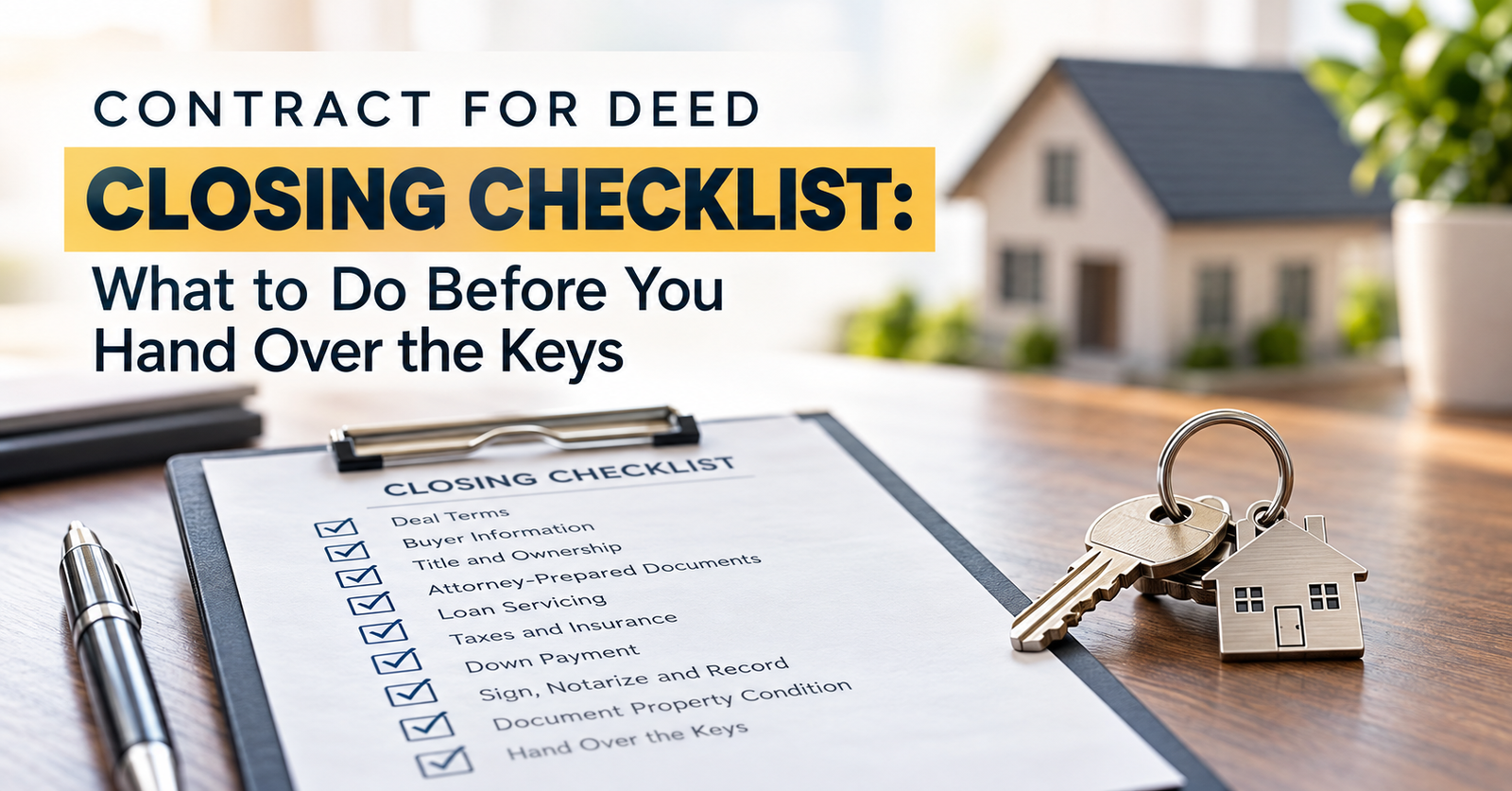
    Contract for Deed Closing Checklist: What to Do Before You Hand Over the Keys

    Your tenant buyer just said yes. Congratulations! Now hold off on the celebration for a minute.

    An accepted offer isn’t the finish line. It’s the start of the stretch where small mistakes get expensive: a misspelled name on a recorded document, a payment amount that doesn’t add up, a property nobody insured, a move-in date nobody wrote down, or a payment system that never actually got set up.

    Quick refresher: a contract for deed (also called an installment land contract, land contract, or agreement for deed, depending on your state) lets the buyer pay toward the purchase over time. Meanwhile, the seller generally keeps legal title until the contract is paid in full.

    One caveat before we dive in. Contract-for-deed laws vary a lot from state to state, so have a real estate attorney who knows these deals in your property’s state review your documents and closing process.

    With that said, here’s a practical checklist to get you from “yes” to “here are your keys” without anything slipping through the cracks.

    1. Lock down the final deal terms

    Before anyone drafts a single document, get every financial term in writing, in one place.

    At a minimum, confirm:

    • Property address
    • Tenant buyer’s full legal name
    • Seller’s legal name or entity
    • Purchase price, down payment, and amount financed
    • Interest rate, loan term, and amortization period
    • Principal and interest payment
    • Monthly tax and insurance amounts
    • Total monthly payment and first payment date
    • Late-payment terms
    • Maintenance and repair responsibilities
    • Prepayment terms and default provisions
    • Possession date

    If those details are scattered across a dozen emails and text threads, you’re asking for trouble. Pull everything into a single deal sheet, then send it to both the attorney drafting the documents and your third-party loan servicer. Everyone works from the same numbers.

    2. Get the tenant buyer’s details exactly right

    Find out precisely how the buyer’s name should appear on the documents before anything gets drafted.

    Collect their:

    • Full legal name
    • Current address
    • Phone number and email
    • Government-issued ID
    • Anything else your attorney or loan servicer needs

    Buying as a couple? Decide up front whether both people will be parties to the agreement.

    It sounds minor, but a single typo can turn into a real headache once documents are signed or recorded.

    3. Make sure the title is clean and the seller is correct

    The seller on the contract must match the owner on record, exactly. If ABC Investments LLC owns the property, the contract can’t just say “John Smith.”

    Review:

    • Current ownership and legal description
    • Outstanding mortgages
    • Recorded liens and judgments
    • Unpaid property taxes
    • HOA balances
    • Any other title issues

    Just bought the property? You may already have a fresh title commitment or policy. Don’t assume that means you can skip a new review. Ask your attorney or title professional what needs updating before you sign a new contract.

    4. Have an attorney prepare the documents

    Resist the urge to download a generic contract and swap in a few names.

    State laws differ widely here. Yours may have specific rules on disclosures, recording, default procedures, foreclosure, cancellation rights, balloon payments, interest calculations, or consumer protections. A template won’t know any of that.

    Depending on your state and deal, your closing package might include:

    • Contract for deed
    • Purchase agreement
    • Seller disclosures
    • Lead-based paint disclosure
    • Payment or amortization schedule
    • Insurance requirements and tax provisions
    • Property-condition acknowledgment
    • Memorandum of contract
    • Loan servicing documents

    Let an attorney experienced in seller-financed real estate decide which ones your deal actually needs.

    5. Set up a third-party loan servicer

    We strongly recommend running payments through a professional third-party loan servicer instead of collecting them yourself. Get it set up well before the first payment is due.

    A servicer keeps an independent record of:

    • Monthly payments received
    • Principal and interest applied
    • Remaining balance
    • Late payments and late fees
    • Tax and insurance amounts collected
    • Full payment history

    That’s cleaner for everyone. No more seller-maintained spreadsheets, no balance math on the back of an envelope, and no trying to reconstruct five years of payment history from bank statements.

    Before closing, confirm the servicing account is live and that your tenant buyer knows:

    • Where to send payments
    • The exact monthly amount
    • The due date
    • Which payment methods are accepted
    • What happens if a payment is late
    • Who to call with questions

    6. Roll taxes and insurance into the monthly payment

    Rather than leaving property taxes and insurance as separate bills, build them into the buyer’s monthly payment.

    Here’s how that might look:

    ItemMonthly amount
    Principal and interest$600
    Property taxes$150
    Property insurance$100
    Total monthly payment$850

    The buyer makes one payment to the servicer, and money for those big annual bills builds up all year long instead of catching someone off guard.

    To get the numbers, start with the expected annual costs and divide by 12. For example, $1,800 in annual taxes works out to $150 a month, and a $1,200 insurance premium works out to $100 a month.

    7. Keep the property insurance in the seller’s hands

    Our preferred setup: the seller buys and pays for the property insurance, then builds that cost into the buyer’s monthly payment.

    Why? Because you still have a lot riding on that property. The last thing you want is to find out months later that the buyer forgot to renew the policy, or let it lapse entirely. When you control the policy, you can always confirm the coverage is active.

    Before closing:

    • Put the right property insurance policy in place
    • Verify the effective date
    • Confirm coverage with your insurance agent
    • Get the annual premium
    • Calculate the monthly amount
    • Add it to the monthly payment

    And be fully transparent with the buyer about exactly what their payment covers.

    8. Require renter’s insurance

    Property insurance and renter’s insurance do different jobs.

    Your property policy generally isn’t meant to cover the buyer’s furniture, electronics, clothing, or other belongings. So require the tenant buyer to carry renter’s insurance for their personal property and personal liability.

    Get proof of coverage before they move in, keep it in your transaction file, and set up a way to track renewals if that makes sense for your deal.

    9. Confirm the down payment has actually cleared

    A signed contract doesn’t mean you’re ready to hand over possession.

    Before the keys change hands, confirm the full down payment and any other closing funds have actually landed in your account. Then document it. Your file should show:

    • The required down payment
    • The amount received
    • The date received
    • The payment method
    • Any balance still owed

    10. Sign and notarize

    Give the closing package one last careful read before anyone signs. Double-check that these are all correct:

    • Names
    • Property address and legal description
    • Purchase price and down payment
    • Interest rate
    • Principal and interest payment
    • Tax and insurance calculations
    • Total monthly payment
    • First payment date
    • Possession date (clearly stated)

    Make sure every required signature and notarization is done, and give the tenant buyer copies of everything they sign.

    11. Record the right documents

    Find out which documents need to be recorded with the county recorder, or should be. This varies by state. Some deals record the full contract; others record a memorandum or a different document.

    Confirm the recording actually happened. Save the recorded copy in your permanent file.

    12. Run through a possession checklist

    Before handing over the keys, document the property’s condition with photos or video of:

    • Every interior room
    • The exterior
    • Appliances
    • HVAC system
    • Electrical panel
    • Plumbing fixtures
    • Any existing damage
    • Other major components

    Then hand over the keys, garage remotes, alarm codes, utility information, and any property instructions. Write down the exact date possession begins.

    13. Build a permanent transaction file

    Once you’ve closed, keep everything together in one organized file:

    • Purchase agreement and contract for deed
    • Recorded documents
    • Buyer’s ID
    • Down payment receipt
    • Amortization schedule
    • Property insurance policy
    • Renter’s insurance verification
    • Tax information
    • Loan servicing agreement and payment instructions
    • Property disclosures
    • Property-condition photos and notes
    • Attorney correspondence
    • Title documents
    • Closing statement

    A contract for deed can run for decades. You won’t remember the details of this closing five or ten years from now, so let the file remember for you.

    The “Don’t Hand Over the Keys Until…” Checklist

    Before possession, make sure you can check off every one of these:

    ☐ Final deal terms are documented

    ☐ Tenant buyer information is verified

    ☐ Title has been reviewed

    ☐ Attorney-prepared documents are complete

    ☐ Documents are signed and notarized

    ☐ Down payment has cleared

    ☐ Seller’s property insurance is active

    ☐ Property insurance cost is built into the monthly payment

    ☐ Property taxes are built into the monthly payment

    ☐ Tenant buyer has provided proof of renter’s insurance

    ☐ Third-party loan servicing is set up

    ☐ Total monthly payment is confirmed

    ☐ First payment date is documented

    ☐ Required documents have been submitted for recording

    ☐ Property condition has been documented

    ☐ Tenant buyer has copies of the agreement

    Then, and only then, hand over the keys.

    A Good Closing Should Be Boring

    Seriously. Boring is the goal.

    No scrambling to insure the property after the buyer has already moved in. No confusion about whether taxes are included in the payment. No guessing where payments go. And no seller squinting at bank statements three years from now trying to figure out the principal balance.

    The recipe is simple: get the systems in place before possession. Use properly prepared legal documents. Run payments through a professional loan servicer. Build taxes and seller-controlled insurance into the monthly payment. Require renter’s insurance. Document the property’s condition. Keep complete records.

    The work you put in before handing over the keys is what makes the next 30 years of this deal easy to manage.

    Ready to Close Your Next Contract for Deed the Right Way?

    A great contract-for-deed deal isn’t just about finding the right tenant buyer. It’s about making sure every piece of the transaction is in place before possession changes hands.

    And juggling attorneys, title work, insurance, loan servicing, payment setup, documents, signatures, recording, and move-in on your own? That’s how things get missed.

    That’s where a transaction coordinator comes in.

    Turnkey TC Solutions helps real estate investors move contract-for-deed deals from accepted buyer to closing. We track the details, coordinate everyone involved, and make sure the right pieces are in place before the keys change hands.

    Have a contract-for-deed deal in the works? Contact Turnkey TC Solutions, and let’s get it organized and across the finish line.

  • You Got the Contract. Now the Real Work Starts.

    You Got the Contract. Now the Real Work Starts.

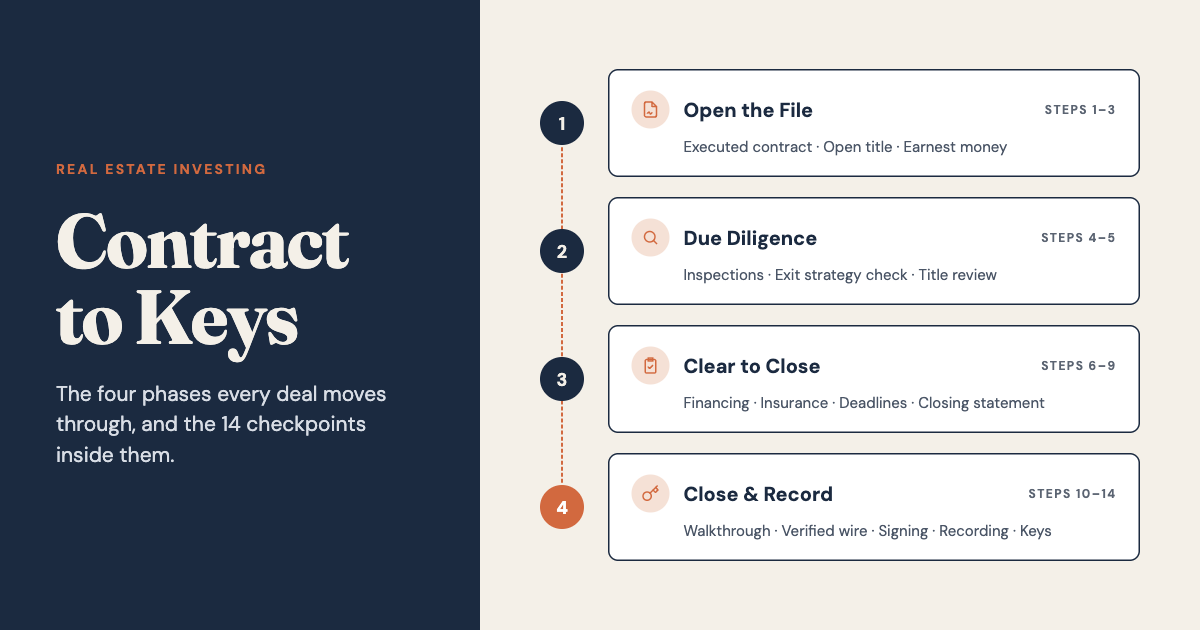
    What happens between “offer accepted” and “keys in hand,” and what smart investors watch at every step

    Getting your offer accepted feels like a win. Enjoy it for about five minutes.

    Then get to work, because the deal isn’t done. It’s just started.

    Between the signed contract and the closing table, there are a lot of moving parts: earnest money, title, inspections, financing, insurance, closing documents, and a stack of deadlines that all run at once. Miss one date or lose track of one document, and a clean deal can get messy fast.

    Here’s what happens after your offer is accepted and what to keep your eye on at each stage.

    Step 1: Get a Fully Executed Contract

    “Accepted” isn’t the same as “signed.” You need a fully executed purchase agreement, meaning every required party has signed and dated it.

    When you get it, don’t just file it. Read it line by line and confirm:

    • Buyer and seller names are correct
    • Your purchasing entity is listed exactly right
    • The property address and legal description are accurate
    • The purchase price and earnest money amount are correct
    • Financing or creative finance terms are included
    • The inspection period is clearly spelled out
    • The closing date is right
    • Seller concessions are documented
    • Any personal property included in the sale is listed
    • Special terms and contingencies are all there

    Buying through an LLC? Check the exact legal name. Fixing it now takes one email. Fixing it three days before closing takes a headache.

    Step 2: Open Title Right Away

    Next, get the deal into the hands of your closing agent. Depending on your state, that’s a title company, escrow company, closing attorney, or real estate attorney.

    Send them the fully executed contract the same day you get it. They’ll open the file and start gathering what they need, which may include:

    • Buyer and seller contact info
    • LLC documents (Articles of Organization, Operating Agreement, EIN)
    • Authorized signer information
    • Financing details and lender contacts

    Doing something creative? Private money, seller financing, subject-to, or any non-traditional structure: tell the closing agent up front. The week of closing is the worst possible time to reveal that this isn’t a standard cash deal.

    Step 3: Deposit Your Earnest Money

    Your contract tells you how much earnest money is due, who holds it, and when it’s due.

    Put that deadline on your calendar right now. Missing it can put your contractual rights at risk.

    Once you send the deposit, get written confirmation that it was received, and keep it in your transaction file.

    Step 4: Start Due Diligence on Day One

    Your inspection period is your chance to find out whether this deal actually works. Don’t waste it.

    Depending on your strategy, due diligence might include:

    • General inspection and contractor walkthrough
    • Roof, HVAC, and foundation evaluations
    • Sewer scope, septic, or well inspection
    • Utility verification
    • Repair estimates
    • Rental analysis and comparable sales review
    • Insurance quotes
    • Property tax review
    • Zoning verification

    Just as important: pressure-test your exit.

    • Renting it out? Confirm what the market will actually pay.
    • Planning a lease option or owner-finance exit? Gauge demand from tenant-buyers.
    • Flipping it? Re-check your ARV and update your rehab numbers.

    Start early. The last day of your inspection period is not the time to discover the roof is shot.

    Step 5: Actually Read the Title Work

    The title company or attorney will run a title search and issue a title commitment or preliminary report.

    Here’s where a lot of investors slip: they file it without reading it. Don’t.

    Title searches can turn up things like:

    • Existing mortgages, including old ones that were never released
    • Judgment, tax, HOA, or municipal liens
    • Unpaid property taxes
    • Easements
    • Probate or ownership problems
    • Code violations

    Some of these clear up in a day. Others can push your closing back weeks. The sooner you spot them, the more time everyone has to fix them. This is also where steady, persistent follow-up makes the biggest difference.

    Step 6: Lock Down Your Financing

    If you’re financing the deal, whether conventional, DSCR, hard money, private money, or transactional funding, your lender should already be working the file.

    Expect them to ask for some combination of:

    • Purchase contract and title commitment
    • Appraisal
    • Insurance binder
    • Entity documents and borrowing authorization
    • Bank statements
    • Scope of work and renovation budget

    And don’t confuse “approved” with “ready to close.” They’re not the same thing.

    Ask your lender one question, early and often:

    “What’s still outstanding before we’re clear to close?”

    Keep asking until the answer is “nothing.”

    Step 7: Line Up Insurance Early

    Insurance is one of the most common last-minute scrambles, and one of the easiest to avoid.

    Call your agent early and tell them exactly how you’ll use the property: rental, flip, vacant, owner-financed, lease option, or short-term rental. The right policy depends on it.

    If you have a lender, they may require specific coverage and need to be listed as mortgagee or loss payee. Have the binder in hand well before closing day.

    Step 8: Track Every Deadline in One Place

    By now, you’ve probably got several clocks running at once:

    • Earnest money deposit
    • Inspection period
    • Financing contingency
    • Appraisal
    • Title objection period
    • Insurance
    • Loan commitment
    • Closing date

    Build a transaction timeline the moment the contract is signed.

    Waiting for someone to remind you isn’t a system. It’s a gamble.

    Step 9: Review the Closing Statement Line by Line

    Before closing, you’ll get a settlement statement, ALTA statement, closing disclosure, or something similar, depending on the deal.

    Check every number:

    • Purchase price and earnest money credit
    • Taxes and prorations
    • Title charges and recording fees
    • Lender fees
    • Seller credits
    • HOA charges
    • Loan payoffs
    • Your final amount due

    See something off? Ask now. Catching a $2,000 mistake before funds go out is easy. Clawing it back afterward is not.

    Step 10: Do the Final Walkthrough

    Right before closing, take one last look at the property (or have someone do it for you). Confirm that:

    • It’s still standing, with no new damage
    • The seller removed their belongings as agreed
    • Included appliances and fixtures are still there
    • Agreed repairs are done
    • It’s vacant, if it’s supposed to be
    • Nobody unexpected is living there

    Investing remotely? Send your agent, contractor, or a local rep, and ask for photos and video.

    Step 11: Wire Your Funds Safely

    Your closing agent will send wiring instructions and your final amount due.

    This is where wire fraud happens, and it happens a lot in real estate.

    Never trust wiring instructions from email alone. Call the title company or attorney at a phone number you’ve independently verified, and confirm the instructions out loud before you send a dime. Then confirm they received it.

    Step 12: Sign Your Closing Documents

    Depending on the deal and where the property is, you may sign:

    • Deed-related documents
    • Settlement statement and closing disclosures
    • Loan documents, promissory note, and mortgage or deed of trust
    • Affidavits and entity resolutions
    • Seller-financing documents

    Buying from out of state? You may be able to use a mobile notary, remote online notarization (where allowed), or mail-away docs. Set this up well in advance, not the day before.

    Step 13: Confirm It Funded and Recorded

    Here’s something many investors don’t realize: signing doesn’t always mean you own it yet.

    The deal still has to fund, and the deed generally has to be delivered and recorded under your jurisdiction’s procedures.

    Don’t call it done until your title company or attorney confirms two words: funded and recorded.

    Once the recorder processes the documents, public records will show the transfer. Save your final signed documents and the recorded deed in your permanent property file.

    Step 14: Grab the Keys and Start the Next Checklist

    Congratulations, you closed!

    Now the real operating work begins. Your post-closing list might look like this:

    • Get keys and access codes
    • Change the locks
    • Transfer utilities
    • Confirm insurance is active
    • Save the recorded deed, final settlement statement, and loan documents
    • Update your books
    • Schedule contractors and start renovations
    • Set up property management
    • Market the property or launch your rental or tenant-buyer exit

    Closing isn’t the finish line. It’s the handoff from acquisition to asset management.

    The Biggest Mistake Investors Make After Going Under Contract

    Assuming someone else is keeping the deal on track.

    Your lender is watching the loan. The title company is watching the title. The agent is watching their piece. The insurance company is handling the policy.

    But who’s watching the whole deal?

    Someone has to track every deadline, chase every missing document, keep every party talking, and catch problems before they turn into delays. Without that person, things fall through the cracks quietly, until suddenly they don’t.

    That’s where a good transaction coordinator earns their keep.

    You Found the Deal. Let Us Handle the Details.

    Your time is best spent finding properties, negotiating deals, raising capital, and growing your portfolio. It’s not best spent chasing title commitments, confirming earnest money, tracking lender conditions, or reminding everyone that closing is in five days.

    Turnkey TC Solutions manages everything between the signed contract and the closing table for real estate investors. We open title, track deadlines, and coordinate with lenders, attorneys, sellers, agents, and closing companies to keep your deal organized and moving.

    Because getting the contract signed is just the beginning.

    Getting it closed is the goal.

  • Who’s Responsible for What in a Real Estate Deal?

    Who’s Responsible for What in a Real Estate Deal?

    Real estate deals have a lot of moving parts.

    Even a simple cash purchase can involve a buyer, seller, agents, a title company, an attorney, a lender, an insurance agent, inspectors, and a transaction coordinator. Add seller financing, private money, subject-to, or another creative structure, and the cast of characters grows fast.

    Here’s where things go wrong: everyone assumes someone else is handling it.

    The title company thinks the buyer is getting the insurance info. The buyer thinks the TC ordered the inspection. The lender is waiting on the title commitment. And the seller still hasn’t signed the amendment.

    Meanwhile, the closing date isn’t moving.

    When you know exactly who owns each piece of the deal, you avoid missed deadlines, pointless delays, and that familiar last-minute scramble. Here’s a practical breakdown of who does what.


    The Investor (That’s You)

    The buck stops with you.

    You can hire professionals to handle specific pieces, but you’re still the one making the business decisions. As the buyer, you’ll typically need to:

    • Sign contracts and amendments promptly
    • Deposit earnest money on time
    • Decide whether to move forward after inspections or due diligence
    • Secure financing
    • Provide entity documents if you’re buying through an LLC
    • Get insurance in place
    • Approve the closing figures
    • Bring funds to closing
    • Make the call when title, financing, inspection, or seller issues come up

    Your transaction coordinator can keep you informed and keep tasks moving, but they generally can’t make financial or legal decisions on your behalf.

    Your move: The moment a contract is signed, make sure someone lists every key deadline in the agreement. At minimum, track:

    • Earnest money deadline
    • Inspection or due diligence deadline
    • Financing deadline
    • Title objection deadline
    • Insurance deadline
    • Closing date

    Don’t trust your memory. Write it down.


    The Transaction Coordinator

    Think of your TC as the hub of the deal. Their job is to get you from signed contract to closed deal by managing communication, documents, deadlines, and follow-up.

    Depending on what’s included in their service, a TC may:

    • Pull the key dates from the executed contract
    • Build a transaction timeline
    • Open the file with title or escrow
    • Send contracts and amendments to the right people
    • Track earnest money
    • Follow up on title work
    • Coordinate with the lender
    • Request insurance information
    • Track inspections
    • Chase down missing signatures
    • Handle closing logistics
    • Keep you updated
    • Organize the final transaction file

    A good TC does more than drop documents into a folder. Their real value is spotting what still needs to happen and following up until it does.

    If title says they’re waiting on LLC documents, your TC flags it for you and gets those documents delivered. If the lender needs the title commitment, your TC chases title and makes sure it lands in the lender’s inbox.

    Your move: Ask your TC exactly what their service includes. Not every TC offers the same thing, so don’t assume.


    The Title or Escrow Company

    In most closings, title does a lot of the heavy lifting. Depending on your state and the deal, they may:

    • Run the title search
    • Issue the title commitment
    • Flag liens or ownership issues
    • Hold earnest money
    • Prepare settlement statements
    • Coordinate the signing
    • Handle incoming and outgoing funds
    • Record the deed and other documents
    • Issue title insurance

    One thing they won’t do is magically fix every title problem. If a judgment, unreleased mortgage, probate issue, tax deed, or ownership discrepancy turns up, you may need extra documentation or legal help to clear it.

    Your move: Don’t wait until closing week to check in on title. Once the file is open, ask regularly:

    • Is the title search done?
    • Are there any title requirements?
    • Do you need anything from the buyer or seller?
    • Is anything likely to delay closing?

    The Real Estate Agent

    When agents are involved, they usually handle negotiating and papering the deal. An agent may:

    • Prepare or submit offers
    • Negotiate price and terms
    • Communicate with the other side’s agent
    • Coordinate inspections
    • Draft amendments or extensions
    • Answer contract questions within the scope of their license

    Agents and TCs often work hand in hand, but their jobs are different. The agent focuses on representation, negotiation, and the contract. The TC focuses on execution, organization, deadlines, and communication once the contract is signed.

    Your move: Decide early who’s responsible for drafting amendments. The last thing you want is to discover two days before closing that everyone assumed someone else was writing the extension.


    The Lender

    If there’s financing, the lender controls a big chunk of your timeline. They may require:

    • The purchase contract
    • The title commitment
    • An appraisal
    • Proof of insurance
    • Entity documents
    • Your financial documents
    • Property information
    • Closing protection documents
    • Final settlement figures

    Private and hard money loans may also call for promissory notes, mortgages, deeds of trust, personal guarantees, or other loan documents.

    Here’s the catch: your deal can be completely clear on the title side and still fail to close because the financing isn’t ready.

    Your move: Ask your lender early, “What do you need from us, from title, and on the property to clear this loan for closing?” Then track every item on that list.


    The Attorney

    Attorneys become essential when a deal involves unusual legal issues or creative financing. You may need one for:

    • Seller-financing documents
    • Promissory notes
    • Mortgages or deeds of trust
    • Contracts for deed
    • Lease-option agreements
    • Entity questions
    • Probate situations
    • Tax deed issues
    • Title disputes
    • Complex amendments
    • State-specific legal requirements

    Your TC can gather information and coordinate document delivery, but a TC is not a substitute for legal counsel.

    Your move: If your deal needs custom legal documents, call the attorney early. Asking for seller-financing docs three days before closing is a reliable way to push your closing date.


    The Insurance Agent

    Insurance is one of the most common last-minute scrambles. Depending on the deal, your agent may need:

    • The property address
    • Purchase price
    • Loan amount
    • Lender name
    • Mortgagee clause
    • Property condition
    • Occupancy status
    • Entity ownership details

    If you’re financing, your lender will likely want proof of coverage before releasing funds.

    Your move: Start the insurance conversation as soon as you know you’re moving forward. Not closing week.


    Inspectors and Other Vendors

    Depending on the property, you might also bring in home inspectors, roofers, electricians, plumbers, surveyors, appraisers, or contractors.

    What they find can decide whether you move forward, walk away, or renegotiate. Your TC may schedule appointments or track deadlines, but reviewing the results and making the investment call is on you.


    The Golden Rule: Every Task Needs an Owner

    Most closing headaches aren’t caused by complicated legal problems. They happen because nobody clearly owns the task.

    Instead of saying, “We need the insurance,” say:

    “Cindy will call the insurance agent today and send the binder to the lender and title by Thursday.”

    Instead of saying, “We’re waiting on title,” say:

    “The TC will follow up with title on Tuesday for the commitment and any outstanding requirements.”

    Every important task should have four things:

    • An owner
    • A deadline
    • A status
    • A follow-up date

    That one simple habit clears up a surprising amount of transaction chaos.


    Build One Central Checklist

    For every deal, keep one place where you can see the whole picture at a glance:

    Contract

    • Executed contract received
    • Key dates entered
    • Amendments completed

    Earnest Money

    • Amount confirmed
    • Deposit instructions received
    • Deposit completed

    Title

    • File opened
    • Title search completed
    • Commitment received
    • Requirements reviewed
    • Issues resolved

    Financing

    • Lender documents submitted
    • Appraisal completed
    • Insurance provided
    • Loan cleared to close

    Closing

    • Final settlement statement reviewed
    • Closing funds confirmed
    • Signing scheduled
    • Documents recorded

    Post-Closing

    • Final documents received
    • Recorded deed received
    • Title policy received
    • Transaction file completed

    Stop Running Your Closings From Your Inbox

    Email is for communication. It’s not a transaction management system.

    Once you’re juggling several properties, it gets easy to lose the thread. One deal is waiting on title. Another needs an amendment. Another is stuck on insurance. Another needs the lender to sign off on final figures.

    That’s exactly where transaction coordination earns its keep.

    Instead of waking up every day wondering, “What am I forgetting?”, you should be able to glance at your pipeline and instantly see what’s done, what’s outstanding, who owns it, and what needs a nudge.

    When everyone knows their role, and someone is actively keeping all the pieces moving, deals get a whole lot easier to manage.

    And for investors trying to grow, that means less time chasing paperwork and more time finding the next deal.